
Key Takeaways
- Size means payload: Agricultural drones are graded by tank and hopper capacity, from compact 20kg-spray units up to 40kg and 75-litre flagships.
- Match to hectares and terrain: A compact drone covers roughly 12 hectares an hour; a flagship reaches 20-plus, but bigger is not better on small or broken country.
- Sensors decide the safe envelope: RTK positioning, phased-array radar, and binocular vision are what let a drone follow terrain and avoid obstacles on hilly or timbered blocks.
- Weight triggers rules: A fully loaded flagship can approach the 150kg limit that changes your CASA obligations, so payload is a compliance decision, not just a productivity one.
- The extras define the day: Battery count, charging, and a generator determine real coverage far more than the headline tank size.
Once you have decided a spray drone belongs on your farm, the next question is sharper: what size? Get it right and one operator clears your paddocks in a day with margin to spare. Get it wrong and you have either bought a machine too small to keep up or a heavyweight that is slow to move, hungry for power, and caught by tighter regulations. This guide walks through payload, coverage, sensors, and the compliance thresholds that should shape your choice, so you buy the drone your country actually needs.
What "size" actually means on a spray drone
With agricultural drones, size is really about payload: how much liquid or granular product the aircraft can lift per flight. That single number cascades into everything else, from coverage rate to battery draw to the rules you fly under. The current market splits cleanly into three tiers.
- Compact (around 20kg spray): A unit like the DJI Agras T25 carries roughly a 20kg spray or 25kg spread payload, is light enough for one person to handle, and suits small to medium or broken country.
- Mid-size (around 40kg spray): The DJI Agras T50 carries about 40kg spraying or 50kg spreading, the workhorse choice for mixed and mid-scale broadacre operations.
- Flagship (70 to 75 litres): The DJI Agras T100 and XAG P150 carry around 70 to 75 litres, built for serious hectares where speed of coverage is the priority.


Compare quotes from expert Australian suppliers and make the best choice. It's free, quick and easy!
Matching payload to coverage and hectares
More payload means fewer refill stops and faster coverage, but the gains are not linear and they depend heavily on your terrain. As a working guide to what each tier clears in open, flat conditions:
| Tier | Spray payload | Typical coverage | Best fit |
|---|---|---|---|
| Compact (T25 class) | ~20kg / 20L | Up to ~12 ha/hr | Small, mixed, or steep blocks |
| Mid-size (T50 class) | ~40kg / 40L | Up to ~21 ha/hr | Mid-scale broadacre and orchards |
| Flagship (T100 / P150 class) | ~70-75L | 20+ ha/hr at higher speed | Large broadacre, high daily hectares |
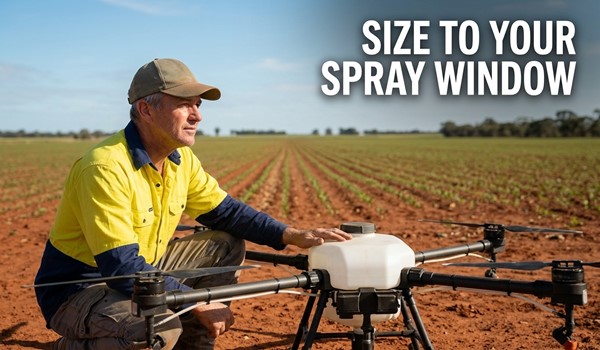
These are best-case figures. Real coverage falls with heavy soil, high application rates, wind, obstacles, and the time lost turning at row ends. On tight or timbered country a flagship's extra tank rarely translates into proportionally more hectares, because you spend the payload advantage manoeuvring rather than spraying. Size to the paddock you spend most time in, not the biggest one you own.
Why sensors matter as much as payload
Two drones with the same tank can behave completely differently over rough ground, and the difference is the sensor suite. This is where the safe operating envelope is set:
- RTK positioning: Centimetre-level accuracy keeps flight lines straight and overlaps consistent, which matters most on prescription and variable-rate work.
- Phased-array radar: Front and rear radar lets the drone follow undulating terrain and hold a set height above the canopy on hills and slopes.
- Binocular vision: Camera-based sensing helps detect and avoid obstacles such as trees, poles, and fence lines in daylight conditions.
- Terrain following: Combined sensing keeps the aircraft at the right spray height as the ground rises and falls, protecting both coverage and the machine.
If your country is flat and open, a modest sensor package will serve. If it is hilly, timbered, or dotted with infrastructure, prioritise the sensor suite over raw tank size, because that is what keeps an expensive machine out of a fence or a gully.
The compliance angle: weight changes the rules
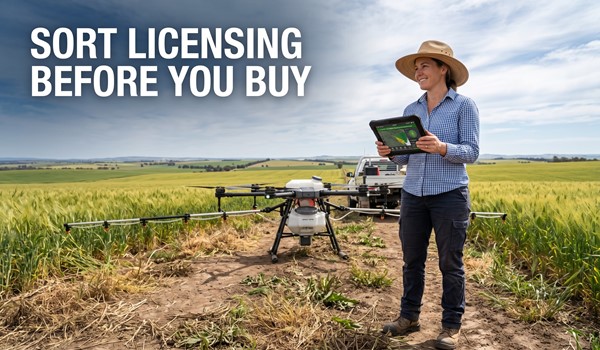
Payload is not only a productivity lever, it is a regulatory one. A fully loaded flagship such as the T100 can approach a maximum takeoff weight near 150kg, and in Australia operators are directed to keep within that ceiling and follow the relevant approvals. Heavier aircraft can push past the category thresholds that determine what accreditation, licensing, or extra approvals you need from CASA. In short, choosing a bigger drone can change your compliance obligations, so factor the paperwork into the size decision rather than treating it as an afterthought.
Don't overlook the supporting kit
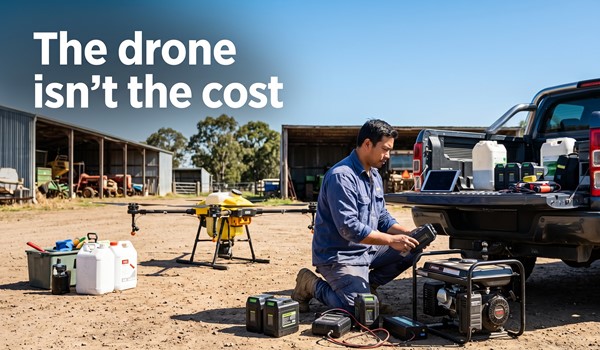
A drone's real output on the day is set less by its tank than by what surrounds it. Flights run only five to six minutes fully loaded, so the number of batteries you rotate, how fast they charge, and whether you run a generator in the paddock will make or break your coverage. A flagship starved of batteries will underperform a well-supported mid-size unit. When you size the aircraft, size the whole system with it: batteries, charging, generator, and a spreader if you also handle granular product.
A realistic scenario
Picture a grower running 600 hectares of flat cereal country plus a few hundred hectares of steep, timbered grazing land carrying weeds. The instinct is to buy the biggest drone available and be done with it.
But the flagship that flies beautifully across the open cereal blocks is exactly the machine that struggles on the tight, timbered slopes, where a lighter, sensor-rich compact unit follows the terrain and threads between trees far better. Depending on the split of work, a mid-size drone with a strong sensor suite may serve both jobs adequately, or the grower may run a compact drone for the difficult country and hire a contractor for the broadacre. The point is that hectares alone do not settle it: terrain, sensors, and compliance all pull on the size decision. If a drone looks marginal for the flat work, it is worth weighing it against a conventional agricultural sprayer or boom sprayer, which still cover far more flat hectares per day, and browsing the agricultural drone listings to compare specs side by side. For how larger farm-machinery purchases are priced and financed, the Australian farm tractor buying guide is a useful companion.
Compare quotes from expert Australian suppliers and make the best choice. It's free, quick and easy!
Frequently asked questions
What size agricultural drone is best for a small farm?
A compact unit around 20kg spray payload, such as the DJI Agras T25 class, usually suits small or mixed properties. It is light enough for one person to handle, covers up to roughly 12 hectares an hour, and manoeuvres well on tight or broken country where a flagship's extra tank goes to waste.
How many hectares can a spray drone cover per hour?
In open, flat conditions a compact drone clears up to about 12 hectares an hour and a mid-size unit up to around 21, with flagships going faster again. Real figures drop with heavy soil, high application rates, wind, and obstacles, so treat headline numbers as a ceiling, not an average.
Do bigger drones need different licensing in Australia?
They can. A fully loaded flagship can approach a 150kg maximum takeoff weight, and heavier aircraft may cross the category thresholds that change your CASA accreditation, licensing, or approval requirements. Confirm the obligations for the specific model and payload before you commit.
What sensors should I prioritise for hilly country?
On slopes and timbered blocks, prioritise phased-array radar and terrain following to hold spray height, RTK for accurate lines, and binocular vision for obstacle avoidance. On flat, open ground a lighter sensor package is adequate, so let terrain drive the sensor spend more than the tank size.
Is a spray or spreading payload the number to compare?
Compare the payload that matches your main job. Spray payloads (liquid) and spread payloads (granular) differ on the same aircraft, with spreading usually rated higher. If you do both, check both figures, and remember a spreader attachment adds cost and changes the aircraft's handling.
What matters most
The right size drone is the one matched to your terrain, your hectares, and your compliance appetite, not simply the largest tank you can afford. Start with the country you spend most time spraying, weigh coverage against manoeuvrability, prioritise sensors on broken ground, and check where the payload leaves you against CASA thresholds. Then size the batteries, charging, and generator to match the aircraft. Choose the drone that fits the work and it earns its keep every season; buy on tank size alone and you pay for capacity your paddocks never use.
Want to compare payloads and specs for your property? Get quotes from agricultural drone suppliers across Australia here.