
Key takeaways
- Every commercial ag drone needs CASA paperwork: if you fly a drone for your farm business, you must register it and hold either operator accreditation or a Remote Pilot Licence (RePL), set by the drone's weight.
- Spraying adds a second rulebook: applying chemicals or fertiliser from the air triggers a separate state chemical licence on top of your CASA credentials. Mapping and livestock work does not.
- Your state decides the chemical layer: Queensland, Victoria, New South Wales, Western Australia, South Australia and Tasmania each run their own aerial chemical rules, and the requirements differ.
- Own land is not a free pass: in Queensland you need a state pilot chemical rating licence to spray even over your own paddocks.
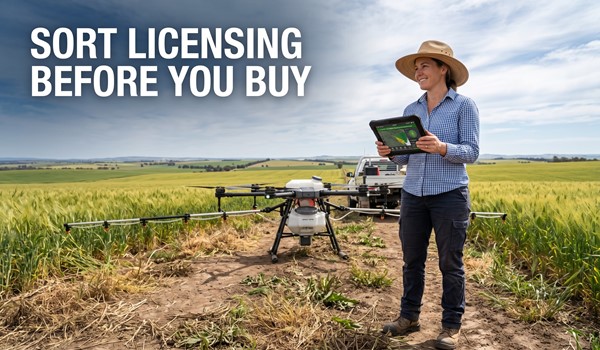
- Sort the licence before you buy: the credential you need is tied to the drone's weight and your intended job, so confirm your pathway before you commit to a model.
Introduction
Licensing is the first real hurdle for most agricultural drone buyers in Australia, and it catches people out because there is no single licence. What you need depends on two things: how heavy the drone is, and what you intend to do with it. A lightweight mapping drone scouting crop health sits under one set of rules. A heavy spray drone applying chemicals sits under those rules plus a whole second layer run by your state. This guide walks through both so you know exactly what your operation requires before you choose a machine.
The rules below apply to commercial and business use, which includes any drone work that is part of running your farm, even when no money changes hands. Recreational flying is a separate, lighter category and is not the focus here.


Compare quotes from expert Australian suppliers and make the best choice. It's free, quick and easy!
The CASA layer: registration and pilot credentials
The Civil Aviation Safety Authority (CASA) is the national body that governs every drone flight in Australia. For commercial agricultural use, two CASA requirements apply to almost everyone, and the exact pilot credential is set by the weight of the drone.
Drone registration
Any drone used for business, including farm work, must be registered with CASA regardless of how much it weighs. Registration is the baseline step that applies whether you are mapping, monitoring livestock or spraying.
Operator accreditation or a Remote Pilot Licence (RePL)
For lighter drones used commercially, between 250 grams and 2 kilograms, you can often operate under the "excluded category" with a free online RPA operator accreditation rather than a full licence. Many crop-scouting and small mapping drones fall here. Once your drone is over 2 kilograms, or you fly outside the standard operating conditions, you need a Remote Pilot Licence (RePL): a formal qualification earned through a CASA-approved training course. Most agricultural spray drones are well over this threshold, so an RePL is the norm for spraying work. If you are weighing models, you can compare agricultural drones by weight class to see which side of the licence threshold each sits on.
Remotely Piloted Aircraft Operator's Certificate (ReOC)
A ReOC is a business-level certificate. Where an RePL covers the individual pilot, a ReOC covers the operation: it lets a business run drone work under its own approved procedures and employ RePL-qualified pilots. Contractors and larger farm businesses commonly hold or operate under a ReOC. It is also the foundation for seeking advanced approvals, such as flying beyond visual line of sight.
The state layer: chemical application licensing
This is the layer that surprises buyers. The moment your agricultural drone applies chemicals or fertiliser from the air, you move into aerial chemical distribution, which is regulated separately by each state and territory, on top of your CASA credentials. If you are only mapping, surveying or monitoring livestock, this layer does not apply to you at all, which is part of why use type matters so much to your licensing path.
Chemical handling competencies are commonly required as part of this layer. The key training units that come up are transport and storage of chemicals, and the preparation and application of chemicals to control pests, weeds and diseases.
Queensland
Under Queensland's agricultural chemical distribution law, anyone applying chemicals from a drone must hold a state pilot chemical rating licence, even when spraying over land they own or lease. A business doing this work also needs an aerial distribution contractor licence. This is the clearest example of own land not being a free pass.
Victoria
Victoria requires a pilot chemical rating licence for anyone piloting a drone to spray agricultural chemicals, and an agricultural aircraft operator licence for the business that owns or operates the drone. Where one person both owns and flies the drone, both licences are needed. The combined fee for both was around $1,076 and the licences run for three years.
New South Wales
New South Wales applies strict buffer rules: discharging chemical within 150 metres of dwellings, schools or public places is not permitted without written permission. Business and pilot requirements apply on top of the CASA credentials.
Other states
Western Australia requires a recognised chemical handling qualification such as SpraySafe accreditation alongside the CASA licensing. South Australia requires state-based accreditation on top of the CASA standards and applies its own buffer distances. Tasmania runs its own operator and chemical rating framework. The common thread across every state is that some form of chemical application licence sits on top of your CASA credentials before you can spray.
How licensing maps to the drone you buy
Because the pilot credential is set by weight, your licensing path and your purchase decision are linked. A sub-2-kilogram mapping drone may only need registration and accreditation, keeping your entry simple. A heavy spray drone almost always needs an RePL, plus the full state chemical layer, which is a longer and more involved pathway. Knowing which side of these thresholds your intended machine sits on tells you how much licensing work is ahead before you can legally fly it. It is worth settling this before you get quotes for agricultural drones, so the model you choose matches the credentials you are willing to obtain.
Common questions from agricultural drone buyers
Do I need a licence to fly an agricultural drone commercially in Australia?
Yes. Any drone used for farm business must be registered with CASA, and you need either operator accreditation (for lighter drones) or a Remote Pilot Licence (for drones over 2 kilograms or non-standard flights). A business operation may also need or operate under a ReOC.
Do mapping and livestock drones need the same licence as spray drones?
They share the CASA registration and pilot credential requirements, set by weight. The difference is that spraying chemicals adds a separate state chemical licence, while mapping and livestock monitoring do not trigger that extra layer.
Can I spray my own land without a chemical licence?
Not in several states. Queensland, for example, requires a state pilot chemical rating licence to apply chemicals from a drone even over your own property. Always check your own state's aerial chemical rules before spraying.
How long does a Remote Pilot Licence take to get?
An RePL is earned through a CASA-approved training course combining theory and practical flight assessment, often run over several days. Once held, it does not expire, so it is a one-off step rather than an annual renewal.
What about flying beyond visual line of sight?
Flying beyond what you can directly see is a complex operation that needs additional CASA approvals and is typically run under a ReOC. New trial pathways have been opening up this area, but it sits well beyond the standard licensing covered here.
Compare quotes from expert Australian suppliers and make the best choice. It's free, quick and easy!
What matters most
Treat licensing as two stacked layers: the CASA layer that applies to every commercial agricultural drone, set by weight, and the state chemical layer that only applies when you spray. Map your intended use and your likely drone weight against both before you buy, so the model you choose matches a credential pathway you are prepared to follow. For a fuller picture of choosing a machine, see our agricultural drone buying guide.
This article is general information, not legal or regulatory advice. Confirm current requirements with CASA and your state authority before operating.
Find the right agricultural drone
Get 3+ quotes so you can compare agricultural drone models, payloads and support from verified Australian suppliers, then choose the one that fits your operation. Get and compare agricultural drone quotes now.