In short:
New businesses can still access equipment finance with a fresh ABN, with specialist lenders typically assessing the owner’s industry experience, deposit, personal credit, expected work and the equipment itself instead of relying on trading history.
Key facts
- The problem: Most lenders want to see one to two years of trading before they lend, and every one of Australia's 437,150 new businesses last year started with zero.
- The good news: Specialist lenders approve brand-new businesses every week. They just look at different things: your deposit, your experience, and the gear itself.
- What helps your case: A deposit of 10 to 20 percent, years of experience in the same trade, a signed contract or work lined up, and a clean personal credit history.
- What it costs: Expect a higher rate or a smaller loan in year one. Once you have a year or two of results behind you, better pricing is realistic.
- Where a broker fits: Knowing which lenders say yes to a fresh ABN, and on what conditions, is exactly what a broker brings when you have no history to show.
Every new business hits the same catch: you need the equipment to earn the money, but lenders want to see the money before funding the equipment. And a lot of people are hitting it. Some 437,150 businesses started up in 2024-25, roughly one new business for every six already trading, according to the Australian Bureau of Statistics. The lending market has an answer: a clear set of pathways built for new ABNs. This guide explains how they work and what your application needs.
How lenders say yes to a business with no history
With no trading results to look at, the lender looks at everything around them instead. Four things carry the application:
- The gear itself: A ute, forklift, or machine that is easy to resell is good security on its own. Standard, popular equipment gets new ABNs approved. Rare or highly specialised gear does not.
- Your own money in the deal: A deposit of around 10 to 20 percent lowers the lender's risk and shows you are serious. Owning property, even with a mortgage on it, helps in a similar way with many lenders.
- Your experience, not the ABN's: Years spent working in the same trade count. A plumber of ten years starting a plumbing business is a much safer bet than a career changer, and several lenders price it that way.
- Your personal backing: Nearly every new-ABN loan needs a personal guarantee, meaning you personally promise to repay if the business cannot. That puts your personal credit history at the centre of the decision, so keep it clean in the year before you launch.
Proof of coming income helps too, even when it is not financial statements: a signed contract, a letter from a builder, or a full order book gives the lender a reason to believe the repayments will be met from month one.
| Your position | Typical outcome on a new ABN |
|---|---|
| Same-trade experience, deposit, clean credit | Approvable with several specialist lenders at a modest premium |
| Fresh ABN, no deposit, renting | Few options; smaller loans and higher prices, the gear type is critical |
| Contract or work lined up | Noticeably more options; proof of income stands in for history |
| Professional startup (e.g. medical, dental) | Dedicated new-practice pathways with specialist healthcare lenders |
Explore finance options
Know what you can access, keep cash available, and move quickly
What it costs and how it gets better
New-ABN lending costs more because the history is missing: a higher rate, a required deposit, or a cap on how much you can borrow, and sometimes all three. But the premium is not forever. Once the business has a year or two of results and a clean repayment record, moving to a better rate is a realistic next step. Treat the first loan as a bridge, not a life sentence. With the usual loan type, a chattel mortgage, you own the gear from day one, and eligible small businesses can also look at the instant asset write-off for assets costing less than $20,000 in 2025-26, explained by the Australian Taxation Office. That is a conversation to have directly with your accountant.
The tricky part is that every lender draws the new-ABN line in a different place: how old the ABN must be, how much deposit, which gear, how much experience. Those rules also shift over time. Applying to the wrong lenders adds marks to a credit file that is already carrying the whole application. EasyAsset places new-ABN applications across more than 50 bank and non-bank lenders and knows which ones are saying yes to startups this quarter, on which gear, and on what conditions.
A realistic scenario
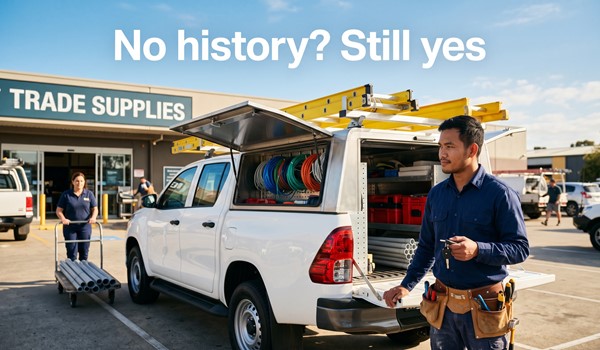
Picture an electrician in Newcastle who left his job in March, registered an ABN, and has a builder's subcontract starting next month. He needs a $65,000 work ute fitted out, and has no financial statements to show. What he does have: ten years in the trade, a 15 percent deposit, a clean personal credit history, and the signed subcontract. A specialist lender approves the loan in three days on exactly those things. The same logic funds a new warehouse operation's first forklift, and a GP setting up their own rooms can use dedicated new-practice pathways through medical equipment finance, where lenders look at what the doctor earned as an employee instead of practice history.
What matters most
A new ABN is an application you build, not a reason to wait a year. Bring what lenders actually weigh up: a deposit, your trade experience, proof of coming work, and a clean personal credit file, and choose standard gear that resells easily. Then have the application placed with the lenders whose rules are built for startups, instead of burning credit checks finding them yourself. This article is general information only and is not financial or tax advice; confirm loan structures and tax treatment directly with your accountant.
Starting out and need the gear before the history? Get a new-ABN ute finance quote here.
Frequently asked questions
Can I get equipment finance with a brand new ABN?
Yes, through specialist lenders that look at the gear, a deposit, your industry experience, and your personal credit instead of trading history. There are fewer lenders to choose from and the price is higher than for an established business, but genuine day-one approvals happen every week.
How much deposit do I need as a new business?
Usually 10 to 20 percent on new-ABN deals, though it varies by lender, gear, and your wider position. Owning property can shrink or remove the deposit requirement with some lenders. No-deposit approvals on a fresh ABN exist but are rare and priced accordingly.
Does my personal credit history matter for business equipment finance?
On a new ABN, it is central. With no business history to judge and a personal guarantee almost always required, your personal file is the best evidence the lender has of how you handle repayments. Keeping it clean before and during your first year protects your options.
Will my rate improve once the business is established?
Often, yes. Once you can show a year or two of results and clean repayments, refinancing to a better rate is a realistic step. Set the first loan up with that in mind rather than treating startup pricing as permanent.
Explore finance options
Know what you can access, keep cash available, and move quickly