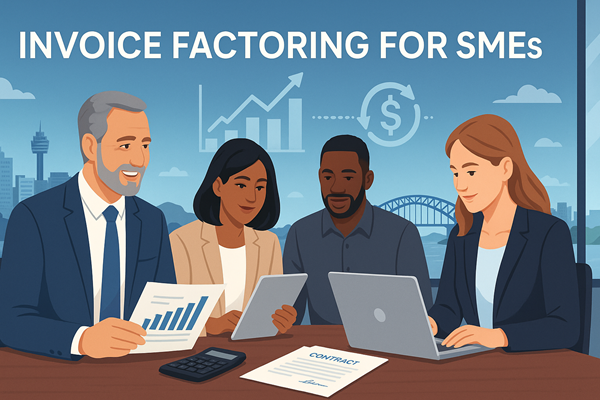
In short:
Discover how invoice factoring affects your GST, BAS, and ATO obligations. Learn how to manage cash flow, avoid tax errors, and stay compliant in Australia.
Factoring your invoices? Find out how it impacts your tax reporting, GST, and BAS submissions—plus practical tips to keep your business ATO-ready.
Key facts
- Invoice factoring is growing fast — In 2024, over $10 billion in receivables were factored by Australian SMEs, helping businesses unlock working capital without adding debt.
- GST still applies on factored invoices — Your business must report the full GST amount on the invoice, even if you only receive part of the payment upfront from the factor.
- Cash flow vs tax timing — Receiving advanced funds doesn’t change when GST is due. You still report GST in your BAS for the period when the invoice is issued (accrual method) or when payment is received (cash method).
- ATO expects full transparency — You must declare factored invoices as part of your Business Activity Statement (BAS) and retain clear records of what’s been factored.
- Tax treatment is complex — There’s no GST on the factoring service fee, but you may be able to claim it as a tax-deductible business expense.
- ATO audit risk — Poorly tracked invoice factoring can trigger audits. In FY2023, the ATO increased audits on small businesses by 35% in sectors showing irregular BAS lodgements or sudden shifts in GST obligations.
Introduction: Invoice factoring is booming—but what about tax?
If you’re using invoice factoring to ease cash flow pressures in your Australian business, you’re not alone. It’s a practical solution—especially in sectors with long payment cycles like construction, manufacturing, logistics, and professional services.
But as more businesses tap into this tool, many overlook the tax consequences.
How does GST work on factored invoices? What are the ATO's rules? And how should you report these transactions in your BAS?
In this article, we’ll break down exactly what you need to know to stay compliant, manage your tax efficiently, and make invoice factoring work for—not against—your business in the eyes of the ATO.
What is invoice factoring?
Invoice factoring involves selling your unpaid customer invoices to a third party (a "factor") at a discount, so you can receive most of the money upfront—usually 80–90% of the invoice value. The remaining balance (minus fees) is paid once the customer settles the invoice.
You're not taking on new debt. You're unlocking cash tied up in receivables. But this creates unique tax implications because you're handing over your legal right to collect payment on a GST-inclusive invoice.
GST implications on factored invoices
Factoring doesn’t change your business's GST obligations. You're still responsible for accounting for GST on the full invoice amount, not just the cash you've received.
Key considerations:
- GST is calculated on the invoice total, not the amount advanced by the factor.
- If your business is on the cash accounting method, you report GST when the payment is received—either from your customer or the factoring company.
- If you’re on the accrual method, you must report GST in the BAS period when the invoice is issued, regardless of whether the customer or factor has paid it yet.
Example:
If you issue a $10,000 invoice including $909.09 in GST and factor it for 85%, you'll receive $8,500 upfront. However, you must still report $909.09 in GST in your BAS, even though you didn’t receive the full amount.
ATO reporting and BAS considerations
The ATO expects full visibility of invoice factoring transactions in your BAS.
What you must do:
- Declare the invoice value and GST in your sales section of the BAS.
- Do not adjust for the factoring fee—this is a business expense, not a GST credit.
- If you're using cash accounting, you may delay reporting the GST until the factor or customer pays.
- For accrual accounting, report the GST when the invoice is issued.
Practical tips:
- Set up a separate ledger for factored invoices in your accounting software.
- Label payments from the factoring company clearly.
- Keep a record of the factoring agreement, payment schedules, and any customer communications.
- If you're unsure whether you're on the cash or accrual method, check your ATO registration or consult your accountant.
Managing tax obligations when cash is advanced
Factoring can confuse your internal cash flow vs tax liability picture—especially if you use advanced funds before the ATO deadline hits.
Here’s how to stay ahead:
- Keep a BAS calendar: Track when each invoice’s GST is due based on your accounting method.
- Forecast your tax obligations: Remember, even though the cash has been advanced, you owe tax on the full amount.
- Don’t overspend the advanced funds before allocating GST.
- Set aside a GST buffer in your working capital or a separate account to prevent tax shortfalls.
- Claim the factoring fee as a deductible business expense—this reduces your taxable income, although it doesn’t offset GST.
Did you know?
In a 2024 NAB survey, 36% of small businesses using invoice finance reported underestimating their GST liabilities, leading to ATO penalties or payment plans. Getting this right avoids nasty surprises.
How factoring fees affect your tax
While the service fee your factor charges you isn’t subject to GST, it is tax deductible.
Tax treatment of factoring costs:
- Factoring fees (typically 1–5%) are considered operating expenses.
- No GST is usually charged on the factoring fee, because it’s a financial supply.
- You can’t claim GST credits on these fees, but you can deduct them as a business expense in your annual tax return.
This helps reduce your taxable profit—so even though you're losing a small cut of your receivables, you recover some value at tax time.
Structuring your chart of accounts for invoice factoring
Getting your accounts right from the start makes BAS reporting and compliance much easier—especially if you factor invoices regularly.
Here’s how to set up your books:
- Factored Debtors Account – Create a sub-account under Accounts Receivable to track which invoices have been factored.
- Factoring Clearing Account – Use this as a temporary holding account when payments are advanced by the factor and later reconciled when your customer pays.
- Factoring Fees Expense Account – Log fees charged by the factoring provider here. These are tax-deductible, but not subject to GST.
Setting this up ensures your accounting software can track invoice flows clearly and makes BAS reconciliation smoother.
Trending issues in 2025: Factoring and tax compliance
Several shifts in the Australian market make factoring and tax compliance even more important this year:
- More scrutiny on SME tax lodgements – The ATO’s 2024–25 compliance program includes targeting businesses with large invoice adjustments, a red flag for improper BAS reporting.
- Digital audits rising – AI-driven audits of STP and BAS data have led to a 25% increase in automated GST discrepancy alerts.
- Cash flow stress growing – As interest rates remain high and insolvency rates grow (up 21% in FY2024, ASIC), more businesses turn to factoring—often without full tax awareness.
Common mistakes to avoid
Avoid these errors to stay on the ATO’s good side:
- Double reporting invoices—e.g., once when issued and again when factored
- Not setting aside GST after receiving funds
- Failing to report factoring fees as deductible expenses
- Misclassifying factoring receipts as sales income
- Not updating your accounting software for factoring workflow.
Conclusion: Get the cash, but don't forget the tax
Invoice factoring is a smart, flexible way to keep your cash flow moving in a tight economy. But with flexibility comes responsibility—especially when the ATO is watching.
Understanding how GST works, how to report transactions in your BAS, and how to treat factoring fees can help you stay compliant and make informed financial decisions.
If you're factoring regularly, now's the time to review your accounting method, GST buffers, and BAS processes. With good habits and sound advice, you can enjoy the benefits of fast cash—without the tax sting.
FAQs: Invoice factoring and tax in Australia
Do I still charge GST on an invoice I'm factoring?
Yes. You charge and report GST the same way you would if the customer paid directly.
Can I delay GST reporting until I receive the cash from the factor?
Only if you're on the cash accounting method. If you're on accrual, GST is reported when the invoice is issued.
Is the factoring fee subject to GST?
No, it’s considered a financial supply, which is GST-free. However, you can claim it as a deductible expense.
Does my factor report anything to the ATO?
No. You are responsible for all GST, BAS, and tax reporting—even if the factor receives customer payments.
What happens if my customer never pays the factored invoice?
If you're using recourse factoring, you may have to refund the advance. You can adjust your GST in a later BAS if the invoice is deemed uncollectable.