

Key takeaways
- Purchase price is a small slice of the real cost: for a typical excavator, depreciation can account for less than 9 percent of annual total cost of ownership, while fuel and operator wages make up more than 72 percent.
- The formula is simple: total cost of ownership equals acquisition cost plus operating costs plus maintenance costs, minus resale value, usually expressed as an annual or per-hour figure.
- Financing is part of the calculation, not separate from it: interest, balloon payments and fees all belong inside your TCO model, not off to the side.
- 2026 has two moving parts worth building in now: a temporarily reduced fuel tax credit rate through to 30 June 2026, and the instant asset write-off reverting from 20,000 dollars to 1,000 dollars per asset from 1 July 2026.
- Start with your top 10 assets by value rather than trying to model your whole fleet at once. Even rough numbers beat no numbers.
Two trucks sitting side by side on a dealer's lot can look identical on price and completely different in what they actually cost your business over five years. The purchase price is the number everyone anchors on, but it is consistently the smallest piece of the real cost. If you are financing equipment for an Australian business in 2026, understanding total cost of ownership, and building financing decisions around it rather than the sticker price, is one of the highest-leverage habits you can build into your buying process.
What total cost of ownership actually includes
Total cost of ownership, or TCO, is the complete financial picture of an asset from the day you acquire it to the day you sell or retire it. It goes well beyond the invoice price to include:
- Acquisition costs: purchase price, GST treatment, stamp duty, delivery and any set-up or installation costs.
- Financing costs: interest paid over the loan term, establishment fees, and any balloon payment due at the end.
- Operating costs: fuel or energy, registration, insurance, storage and operator wages where relevant.
- Maintenance costs: scheduled servicing, consumables, and unplanned repairs.
- Resale value: what you can recover when you sell or trade the asset, which acts as a credit against everything above.
The formula, and why the purchase price misleads you
The basic calculation is: acquisition cost plus operating costs plus maintenance costs, minus resale value. An Australian analysis of heavy equipment costs puts this in sharp relief. For a 200,000 dollar excavator with a 40,000 dollar residual value after eight years, annual depreciation works out to 20,000 dollars, less than 9 percent of the annual TCO for that machine. Fuel and operator wages, by contrast, make up more than 72 percent of the total. Purchase price is a poor proxy for real cost precisely because it is the one number buyers fixate on and the one that matters least once the asset is actually working.
| Cost category | Approx share of annual TCO | What it includes |
|---|---|---|
| Fuel and operator wages | 72 percent or more | Running cost, loaded hourly labour rate, super and on-costs |
| Depreciation | Under 9 percent | Purchase price less residual, spread over useful life |
| Maintenance and consumables | Remainder | Scheduled servicing, tyres, filters, unplanned repairs |
| Finance, insurance and admin | Remainder | Interest, insurance premium, registration, storage |
These proportions vary by asset type and utilisation, but the pattern holds broadly across Australian operations: the cost of running and maintaining equipment dwarfs the cost of owning it.
Why financing belongs inside the TCO model
It is tempting to treat financing as a separate decision from TCO, but interest and structure directly change the number. A truck financed with a large balloon payment carries more total interest across the term than the same truck financed without one, and that extra interest belongs in your TCO alongside fuel and maintenance. Analysis of the current Australian equipment finance market shows the average amount requested for machinery or equipment finance sits around 117,394 dollars, which gives a useful benchmark for how much interest cost is actually in play across a typical five to seven year term at current rates.
Two 2026 numbers that change your calculation
Two current settings are worth building into your model right now rather than assuming last year's numbers still apply.
Fuel tax credits
The fuel tax credit rate changed from 1 April 2026, with the heavy vehicle road user charge set to zero for the June 2026 quarter. This temporarily lifts the effective credit rate for heavy vehicles on public roads, which materially affects the fuel line in your TCO for trucks and heavy plant during this window. Rates are reviewed again in August, so do not assume the same figure applies to your next BAS.
Instant asset write-off cliff
The 20,000 dollar instant asset write-off applied through to 30 June 2026, reverting to a 1,000 dollar threshold from 1 July 2026 unless further legislated. This does not change your TCO directly, but it changes the timing and structure of deductions on smaller ancillary equipment bundled into an asset purchase, which is worth factoring into the acquisition cost line of your model.
A practical example
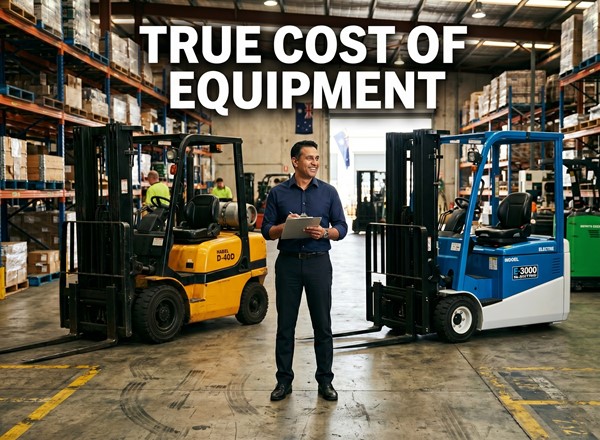
A civil contractor is comparing two forklifts for a new warehouse. Forklift A costs 45,000 dollars with modest fuel efficiency and a five-year manufacturer service plan. Forklift B costs 38,000 dollars but burns noticeably more fuel per shift and has a patchier parts and service network. On purchase price alone, B looks cheaper. Once fuel, projected maintenance and expected resale value are modelled over a six year hold, A comes out ahead by several thousand dollars in total cost, despite the higher sticker price. That gap only becomes visible once the full TCO calculation is run.
Building your own TCO model
- Start with your highest-value assets: pick your top 10 assets by value rather than trying to model an entire fleet at once.
- Gather what you have, estimate what you do not: most businesses already have purchase prices and fuel costs, but are missing accurate maintenance breakdowns and downtime records. Note the gaps and fill them with reasonable estimates.
- Track costs at the asset level going forward: record fuel, maintenance, insurance and registration against the specific asset, not as a lump business expense.
- Include financing on equal footing: add interest, fees and balloon cost to the model rather than treating the loan as separate from the asset.
- Review quarterly: fuel prices, maintenance needs and resale values all shift, so TCO is not a one-off exercise.
Frequently asked questions
What is included in total cost of ownership that the purchase price leaves out?
Financing costs, fuel or energy, insurance, registration, storage, maintenance and operator wages all belong in the calculation, alongside the resale value you can recover at the end. For most equipment, these ongoing costs dwarf the purchase price over the asset's life.
What percentage of equipment running cost is depreciation versus fuel and labour?
For many equipment types, depreciation makes up less than 9 percent of the annual total, while fuel and operator wages can exceed 72 percent. Fixating on the purchase price, and by extension depreciation, misses where the real cost sits.
Should I include financing costs in my TCO model?
Yes. Interest, fees and any balloon cost are part of the real cost of owning the asset, not a separate decision. A finance structure with a large balloon carries more total interest than one without, and that belongs in the model alongside fuel and maintenance.
What matters most
The businesses that consistently make the best equipment decisions are not the ones with the lowest purchase prices, they are the ones who can see the whole cost picture before they sign. Building a simple TCO model for your next few major purchases, and matching the finance structure to that real cost rather than the invoice price, is one of the more reliable ways to protect margin in a business that runs on cash flow as much as it runs on equipment.
Want help matching the right finance structure to the true cost of your next equipment purchase? Click here to get a free quote.