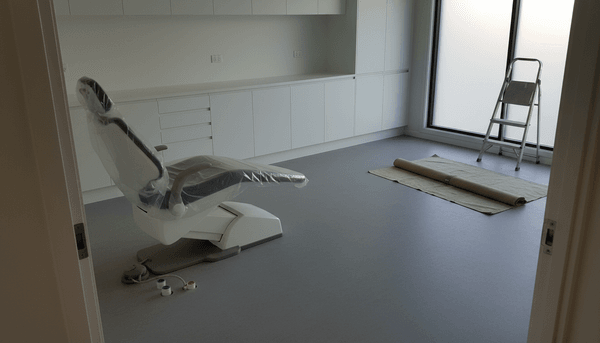
In short:
One independent Melbourne cost guide puts a 100 square metre dental fit-out at $162,500 to $315,000 before clinical equipment. A new site doesn't close you. A renovation can shut the practice for around eight weeks, or not at all if the work is staged around patients.
Key facts
- Builders price it by the square metre: One independent cost guide, updated in November 2026, puts medical and dental suites in Melbourne at $1,625 to $3,150 a square metre, typically $2,375.
- Equipment is a separate budget: That rate covers the build. Chairs, sterilisers and imaging are quoted on top.
- The services set the price: Suction and compressed air piped to each chair, a sterilisation room and lead lining where imaging goes in are what make a surgery dearer to build than an office.
- Approvals can outlast the build: One practice owner interviewed by the Australian Dental Association WA said council approval and planning was the longest part of the job.
- Lenders split a fit-out into parts: Equipment, built-in works and the cash to cover a closure are each treated differently.
Most of what's written about dental fit-outs, including our own earlier articles, is about how to pay for one. The two questions practice owners search for come first: what will it cost, and how many weeks of patients will I lose? This article pulls together published Australian figures on both, then shows how the answers change what you ask a lender for.
EasyAsset is a finance broker, not a builder or a quantity surveyor. The figures below come from published guides and case studies, not from quotes on your site. Treat them as a starting range and get your own quotes from fit-out firms that build dental surgeries.
What a dental fit-out costs
Builders usually price the construction by floor area. The independent cost guide What's The Damage, which says its prices were verified in November 2026, puts a medical or dental suite in Melbourne at $1,625 to $3,150 a square metre, with $2,375 as its typical figure. That is the build only. The guide treats clinical equipment as a separate budget.
| Practice | Floor area | Build cost at that rate |
|---|---|---|
| Small clinic | 100 square metres | $162,500 to $315,000, typically $237,500 |
| Mid-sized practice | 150 to 300 square metres | $243,750 to $945,000 |
Those are Melbourne figures. Rates differ by city, by the state of the building and by how many surgeries you're putting in, so use them to sanity-check a quote, not to replace one.
Equipment sits on top. An older guide on MedicalSearch, our medical marketplace, last updated in January 2025, breaks a dental fit-out into its parts and puts dental equipment and technology at $50,000 to $300,000, depending on how many chairs and how much imaging you buy.
What pushes the price up
A dental surgery costs more to build than an office of the same size because of what runs under the floor and behind the walls. The same cost guide lists the main drivers:
- Chair count. The guide calls it the practical cost driver, because each extra surgery adds services, joinery, equipment and floor area, so the budget rises in steps.
- Services to each chair: water, waste, power, data and air.
- Suction and compressed air, piped to every chair from a plant space that has to be acoustically treated.
- A dedicated sterilisation room, with benching, provision for the autoclave and ventilation.
- Radiation shielding, which means lead lining wherever imaging is installed.
- Clinical joinery.
It also notes that equipment lead times are often longer than construction lead times. Order the chairs and imaging late and a finished room can sit empty while the rent keeps running.
How long you'll be closed
It depends on which of three jobs you're doing.
| The job | Are you closed? | What it costs you |
|---|---|---|
| New premises, then a move | No. The old practice trades until moving day | Two rents for a while |
| Renovation in stages | No, but with fewer chairs working | A longer build and fewer appointments |
| Renovation with a full closure | Yes | No revenue while the fixed costs continue |
The Australian Dental Association WA published two renovation case studies in its series Renovating a practice, and they show both ends.
- One practice went from two surgeries to three and "temporarily ceased operations for eight weeks to allow the construction works to be completed safely and efficiently".
- The other stayed open. Its owner says the team worked around the builders, using dental rooms as temporary offices and the surgical area as a temporary reception. The renovation itself took about six months.
That owner also said the build wasn't the slow part: "The longest part was the council approval and planning stages". Approvals happen before the tools come out, so they don't close you, but they do decide when a closure can start. Ask your builder and certifier what your site needs before you set dates with patients and staff.
The finance advice in the same article is worth repeating. If the practice has to close or cut back appointments, work out how the fixed costs will be paid while revenue is down.
Worked example: a three-chair renovation
This is an example with round numbers, made up to show how the budget fits together. It isn't a quote, a real practice or advice.
- A 100 square metre practice renovates at the guide's typical Melbourne rate of $2,375 a square metre, so the build is $237,500.
- It buys $150,000 of equipment: chairs, a steriliser and imaging.
- It closes for eight weeks. Rent, wages and other fixed costs run at $7,500 a week, so the closure costs $60,000 with no patients coming in.
| Part | Amount | How lenders tend to see it |
|---|---|---|
| The build | $237,500 | Built-in works. Hard to secure, so it leans on the practice and its owners |
| The equipment | $150,000 | Can secure its own loan |
| The closure | $60,000 | Working capital, usually a separate facility |
| Total to plan for | $447,500 |
The builder's quote is just over half of what this practice has to find. Staging the work to stay open would cut the $60,000, but it would stretch the build and take chairs out of use along the way. Neither choice is wrong. It's a sum to do before you sign, not after.
How the finance fits together
Lenders don't see a fit-out as one thing, which is why the split above matters.
- Equipment is the simpler part. A chair or an imaging unit can secure its own loan. Installation, training and software can sometimes go on the same loan when they're on the same invoice, case by case and lender by lender.
- Built-in works are harder. Walls, plumbing and joinery can't be taken back, so they're hard to fund as a secured loan. An equipment line can work instead, and the lender will look more closely at the practice and the people behind it.
- The closure is a cash flow question. If you'll be shut, or running on fewer chairs, plan the working capital at the same time as the build, not when the first rent falls due.
We work with 60+ lenders, including lenders that focus on healthcare, and they don't all treat a fit-out the same way. Bring the builder's quote, the equipment quotes and the closure you expect, and we can match each part to the kind of lender that suits it.
Planning a fit-out? Start a dental fit-out finance quote with EasyAsset here.
The broker's view
Most dentists come to me with the builder's quote and nothing set aside for the weeks the chairs are empty. I'd rather see the whole picture up front: the build, the equipment and what it costs to keep the doors shut. Then each part can go to the kind of lender that suits it, instead of one loan trying to do three jobs.
Frequently asked questions
How much does a dental fit-out cost per square metre?
One independent cost guide, verified in November 2026, puts medical and dental suites in Melbourne at $1,625 to $3,150 a square metre for the build, typically $2,375. Rates vary by city and by site, and clinical equipment is extra.
Is dental equipment included in the fit-out cost?
Usually not in a per square metre rate. Chairs, sterilisers and imaging are quoted separately, so ask every builder whether their figure includes equipment before you compare quotes.
How long does a dental fit-out take?
There's no single figure. In one case study published by the Australian Dental Association WA, the renovation took about six months once approvals were through, and the owner said council approval and planning took longer than that. Ask for a timeline tied to your site.
Do you have to close the practice during a renovation?
Not always. One practice in the same case studies closed for eight weeks, and another stayed open by moving rooms around while the builders worked. Staying open usually means a longer build with fewer chairs in use.
Can you finance the fit-out and the equipment together?
They can be arranged at the same time, but lenders treat them differently. Equipment can secure its own loan, while built-in works lean on the practice and its owners. A broker can set up the parts side by side.
Ready to buy? See Dental fitout finance for rates, terms and how to apply.